Relating publications to thesis sections
Sections of your writing that are exclusive to your thesis, which do not appear in your publications, can help integrate your publications by guiding readers to see links between your thesis and those publications. These links can demonstrate a strong sense of control over the design of your thesis and show examiners that you can connect the parts to the whole seamlessly.
The role of thesis sections in integrating your publications
-
Gives you the chance to frame, explicitly, the relationship between your publications and the thesis (the examples given below this presentation will indicate some ways to do this).
-
- Relates directly to your overarching research question
- Is more comprehensive and contains more detail than the background sections of publications
- Can include a paper for publication, which may need modifying so that it addresses your thesis question with an appropriate breadth and depth.
-
If the methods in your included publications don’t demonstrate the overarching approach of the thesis, or if they have evolved since, consider:
- Writing an overview of the methodology and its development in the introduction or a separate methodology chapter.
- Discussing how the methods reported in the publications link to the overarching methodology in the introduction or reflection sections of the chapters that contain the publications.
-
A chapter that contains publication typically begins with an added introductory section. In this section, you can:
- List the paper(s) included in the chapter.
- Briefly overview its specific aims or hypotheses in the context of the whole thesis.
- State any changes you’ve made to the original paper (additions, deletions and other modifications) and briefly give reasons for these changes.
-
If a publication forms sufficient material for a chapter, a basic chapter structure including an introductory section followed by the paper is a great choice. However, if the publication forms only part of the chapter, consider a more complex chapter structure, such as the following:
- Introduction – including specific aims and hypotheses
- Methods not included in the paper
- Results not included in the paper
- Paper 1
- Discussion – extension of the paper’s discussion, further method development
-
While chapters that include publications usually highlight their specific contributions, the overall thesis discussion or conclusion should state the combined significance of all the findings at a more conceptual level.
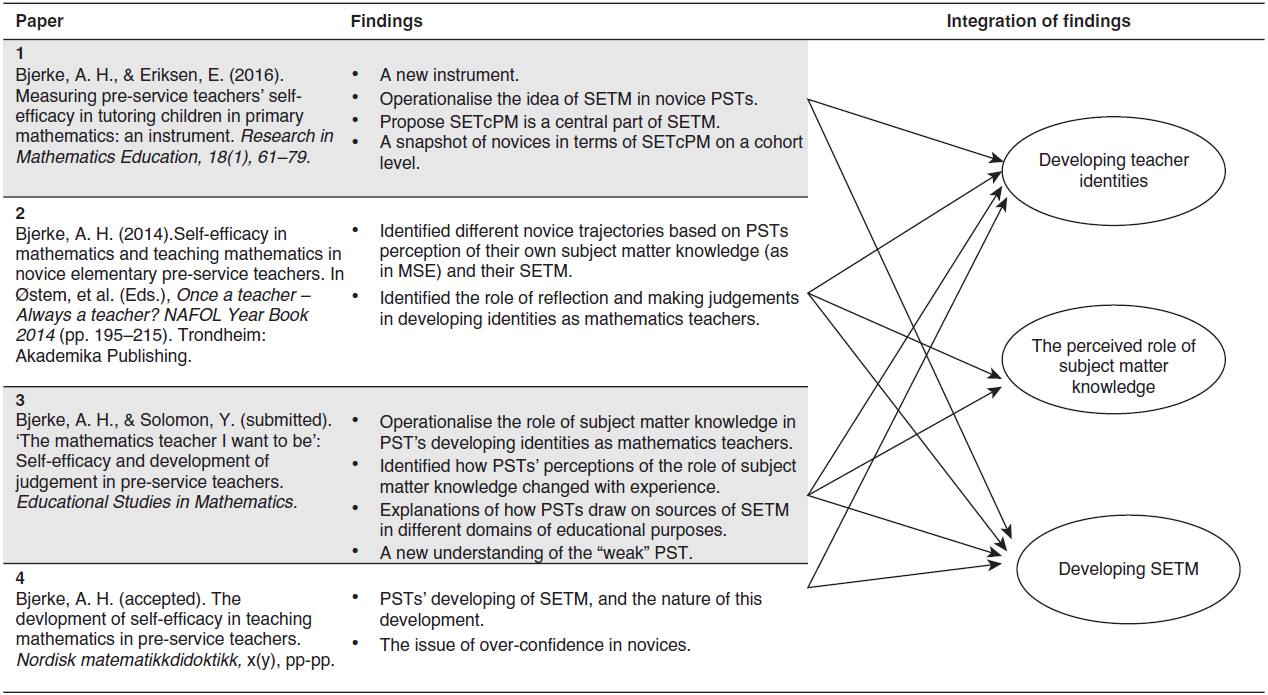
You can synthesise findings from your papers using visualisation, such as in this example:
Visualising integration of findings across publications using bullet points and arrows (Bjerke, 2017, cited in Nygaard & Solli, 2021, p. 145)
Explore an example
This example raises your awareness of the different roles the thesis introduction plays in connecting publications to the thesis. In the presentation below, you will read three introduction excerpts from a history thesis (adapted from Mody, 2018, pp. 1–19). Answer the question on each slide, then turn the card to read the analysis. Some key language has been bolded to aid you.
*If content below does not display, please refresh your browser window
Use the side menu to go the next section: Establishing a cohesive narrative, where we look at how to approach the narrative for a thesis that includes publications.