Making the most of meetings
Meeting with your supervisor at regular intervals will help you prioritise your goals and stick to deadlines. You are expected to be proactive in consulting with your supervisor to organise practical details such as meeting times and agendas. To get the most out of meetings, consider how best to prepare, participate and follow up on issues that arise.
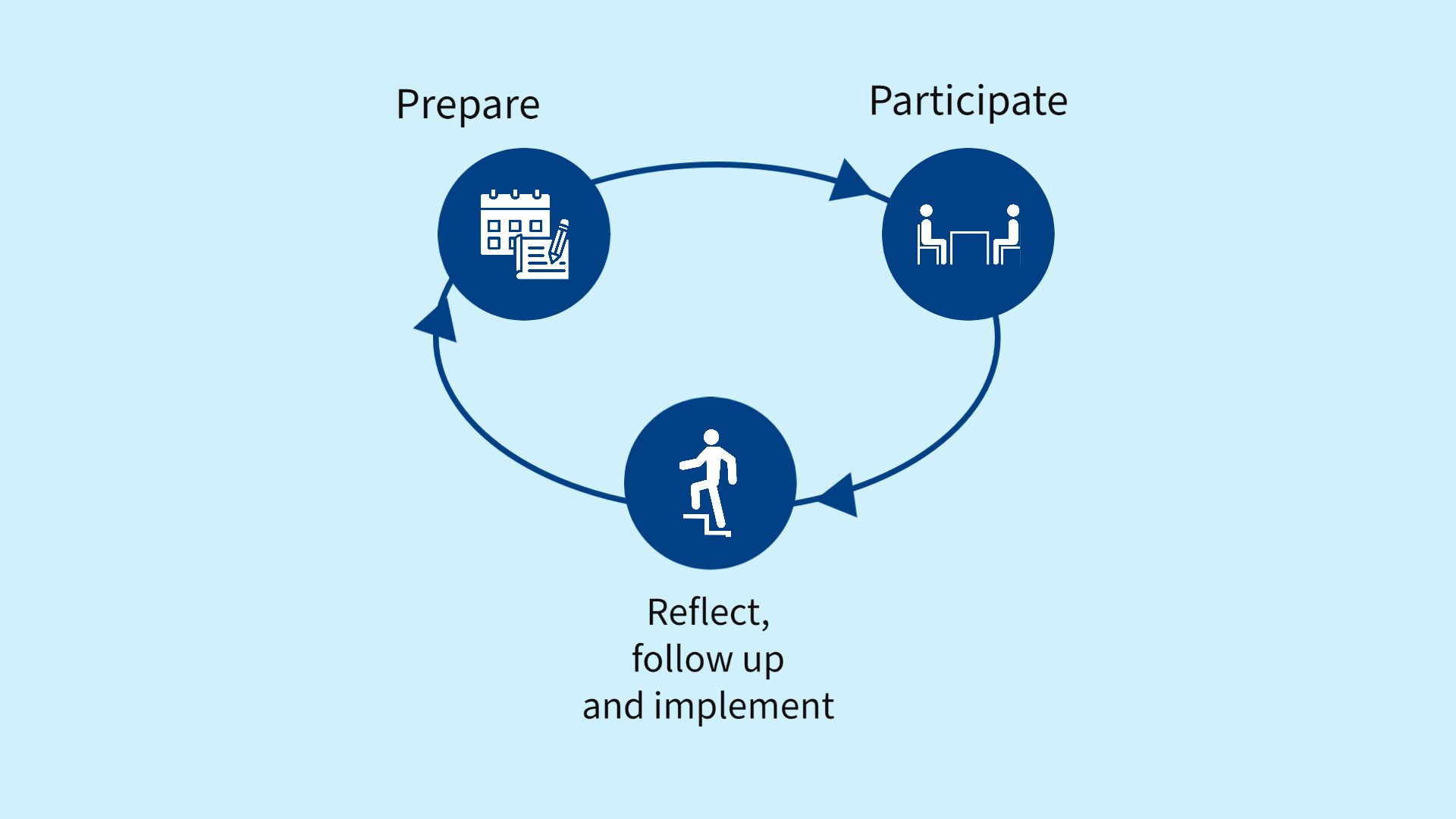
Before the meeting
Make an agenda
...for discussion and send it to your supervisor, with the understanding that they may have other priorities and that you may not have time to cover all of the items.
Your agenda could include:
- Achievements since the last meeting
- Issues and questions about your work, readings or resources
- Insights you have gained and how they have influenced your thinking about your research.
Consider informing your supervisor in advance if you wish to discuss any major issues, such as changes to your time fraction or your research directions.
During the meeting
Take notes
...of your supervisor’s questions, feedback and suggestions. You are expected to respond to what is discussed in the meeting, either by agreeing and following up on feedback or by negotiating and presenting your scholarly viewpoint.
Be objective
...about evaluation and feedback. It is in your supervisor’s best interests as well as yours that you succeed, so try to interpret any challenges to your approach as helpful and instructive. You can disagree diplomatically, and the discussion which follows can improve your understanding and your ability to explain your research.
Seek clarification
...if any discussion points are unclear to you. Consider using direct and polite questions - for example:
- ‘I don’t understand this point. Can you explain a bit more?
- ‘Can you explain that again please?'
- ‘Can you give me one or two examples of where I should have done this?’
- ‘Can I just check that my next step is to work on …, or should I be focussing on something else?’
- ‘So, you mean …. Is that right?’
- ‘What should I prioritise to help me improve?’
After the meeting
Review your notes
...with the intention to:
- Clarify your understanding of the discussion
- Record any deadlines in your calendar or planner
- Add reflections or ideas that came to you as a result of the meeting
- Capture any new or outstanding issues
- Plan your next steps towards delivering any short-term goals you committed to.
Email relevant information
...from your notes to your supervisor as a record, if you think that would be helpful for you both.
Follow up
...on any uncertainty or confusion that remains about anything discussed.
You can write these reflections down while they are fresh, then decide whether you will follow up on them with your supervisor via email or in the next meeting.
Use the side menu to go the next section: Managing your research and writing, where we look at the core graduate research tasks and tips for making them manageable.